
Many European investors assume that real assets — property portfolios, renewable energy plants, timberland — are exclusively the domain of pension funds and institutional giants with tens of millions to deploy. That assumption is quietly becoming outdated. Crowdfunding platforms are reshaping access, allowing everyday investors to participate in tangible, physical investments such as real estate, infrastructure, natural resources, commodities, agriculture, and timberland from as little as a few hundred euros. If you’ve been sitting on the sidelines wondering whether real assets belong in your portfolio, this guide will walk you through everything you need to know. 🚀
Key Takeaways
| Point | Details |
|---|---|
| Real assets are physical | They include real estate, infrastructure, commodities and offer tangible economic value. |
| Diversification and protection | Investing in real assets spreads risk and can help shield portfolios from inflation. |
| Access is increasing | Crowdfunding platforms now make it possible for retail investors across Europe to participate. |
| Manage risks thoughtfully | Illiquidity, volatility, and platform risks should be addressed with expert-backed strategies. |
| Expert tactics improve outcomes | Focusing on CPI-indexed leases, low LTV and diversification enhances long-term returns. |
What are real assets?
Let’s clear up the confusion first. Real assets are physical, tangible things that hold intrinsic value. They are not paper claims like shares or bonds. A share in a listed company is a financial asset because its value derives from a legal claim on future earnings. A solar farm in southern Spain is a real asset because it physically exists, generates electricity, and produces cash flows from that physical activity.
According to Fidelity’s definition, real assets include:
-
🏢 Real estate: Residential, commercial, and industrial property
-
⚡ Infrastructure: Toll roads, airports, energy grids, and renewable plants
-
🌾 Agriculture and timberland: Farmland, forests, and natural resource land
-
🛢️ Natural resources and commodities: Oil, gas, metals, and minerals
What makes real assets distinct from financial assets is their relationship with the physical world. They tend to retain value even during periods of monetary instability, because their worth is anchored to something you can see and touch. For European investors, this distinction matters enormously in an environment where inflation and interest rate volatility have made traditional fixed income less reliable.
“Real assets offer a fundamentally different risk profile to equities and bonds. When paper assets lose purchasing power, physical assets often hold or gain value — particularly those tied to productive land, energy output, or essential infrastructure.”
The European real asset landscape is also broader than many investors realise. Beyond residential property (the most familiar category), there are growing opportunities in solar and wind projects, forestry carbon credits, agricultural land funds, and co-invested infrastructure projects. Understanding this full spectrum is the starting point for building a genuinely diversified portfolio. 🌱
Why invest in real assets?
Understanding what they are sets up why you’d want to invest. The case for real assets rests on three primary pillars: diversification, inflation protection, and income generation. But there are important caveats worth knowing upfront.
Diversification that actually works
Real assets have historically shown low correlation with equities and bonds. When stock markets correct sharply, infrastructure and agricultural land often behave differently because their cash flows are driven by physical demand, not investor sentiment. As Newton Investment Management explains, real asset exposure via private funds, REITs, listed securities, or crowdfunding platforms provides genuine diversification alongside inflation protection and income from rents, yields, or contracts.
If your portfolio currently sits entirely in equities and bonds, adding even a 10 to 15% allocation to real assets can meaningfully reduce overall volatility. The key is selecting assets with different demand drivers. Renewable energy income, for example, depends on weather and regulation, not corporate earnings cycles.
Inflation protection explained
Real assets are often described as inflation hedges, and this is mostly true, but with important nuance. Property with CPI-indexed lease agreements directly adjusts income to inflation each year. Infrastructure assets like toll roads often have inflation-linked revenue structures built into their contracts. Commodities such as gold and energy resources also tend to rise in nominal price terms during inflationary periods.
However, not every real asset automatically protects against inflation. A property with a fixed-rate lease provides no automatic uplift. Agriculture can suffer from commodity price swings unrelated to broad inflation. This is why understanding the specific contractual and operational structure of any real asset investment is essential before committing capital.
Income generation from tangible sources
One of the most appealing characteristics of real assets is their ability to generate regular income. Rental yields from commercial property, energy payments from solar farms, and crop revenues from agricultural land all create cash flows that investors can receive as distributions. This is particularly attractive for European investors seeking income alternatives to low-yielding government bonds.

The liquidity trade-off and how crowdfunding helps
There is a real downside: liquidity. Selling a directly owned commercial building takes months and involves significant transaction costs. Private real asset funds often have lock-up periods of five to ten years. For retail investors, this creates a genuine barrier to entry.
The Sustainable Finance Observatory notes that real assets offer stability and diversification versus stocks and bonds, but lower liquidity. Crowdfunding democratises access for retail investors, albeit with platform and project risks compared to institutional funds.
This is precisely where European crowdfunding platforms step in. By diversifying with fractional ownership, you can participate in real asset projects with much lower minimum investments, effectively spreading capital across multiple projects and reducing concentration risk.
Pro Tip: Even if you find an exciting project, never allocate more than 10% of your total investment capital to a single real asset crowdfunding opportunity. Concentration risk is the most common mistake new investors make.
Investing mechanics: Direct, indirect and crowdfunding
With the benefits clear, let’s examine how you can actually invest in real assets. There are three primary routes, each with a different risk and accessibility profile.
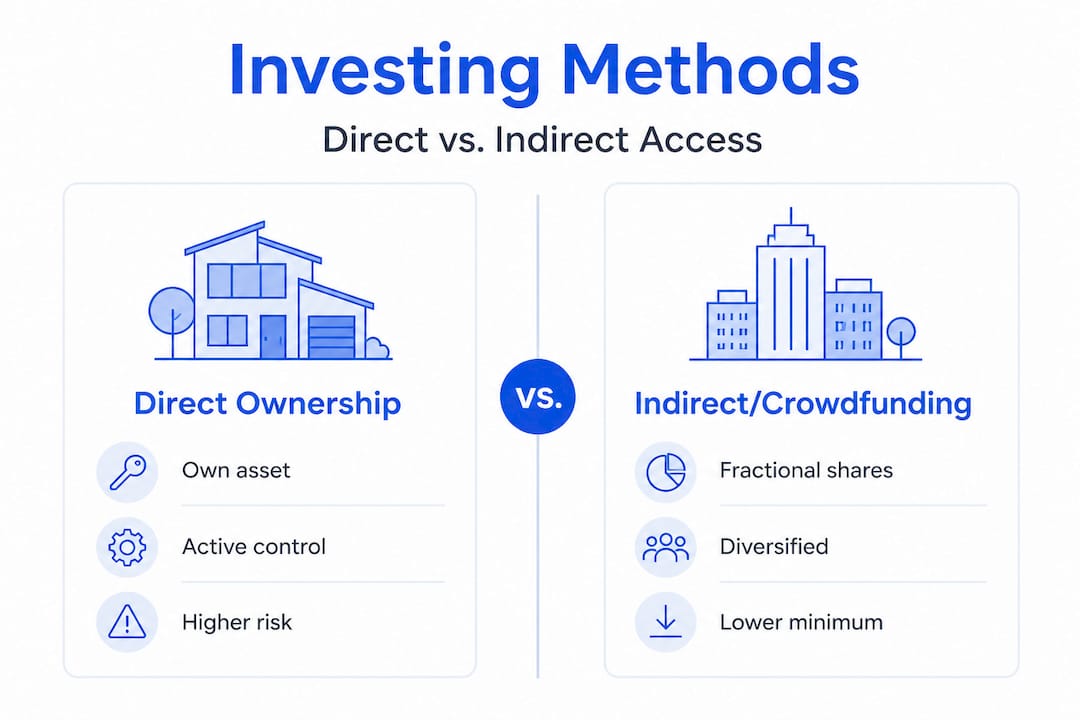
1. Direct ownership
Buying property outright or acquiring physical commodities is the most straightforward approach. You own the asset directly. The advantages are full control, no intermediary fees, and direct receipt of income. The disadvantages include high capital requirements, management burdens, transaction costs, and very low liquidity.
2. Indirect investment via REITs and funds
Real Estate Investment Trusts (REITs) allow you to buy shares in a diversified portfolio of properties via a stock exchange. Listed infrastructure funds work similarly. These offer daily liquidity, professional management, and relatively low minimum investments.
Real asset investing mechanics also include private funds and ELTIF 2.0 structures, which are increasingly available to European retail investors following regulatory reform. These provide exposure to unlisted real assets with more transparency than pure private placements.
Our real estate investing guide covers the European REIT and fund landscape in depth if you want to explore this route further.
3. Crowdfunding platforms: The democratised route
Crowdfunding has genuinely changed the game. Platforms allow you to invest in specific real estate development projects, renewable energy installations, agricultural ventures, or business loans with tickets starting from €100 to €500.
Here is a quick comparison of the three main access routes:
| Method | Minimum investment | Liquidity | Control | Risk level |
|---|---|---|---|---|
| Direct ownership | €50,000+ | Very low | High | Concentrated |
| REITs / listed funds | €100+ | High | Low | Moderate |
| Crowdfunding platforms | €100 to €500 | Low to medium | Medium | Variable |
| Private funds / ELTIFs | €10,000+ | Low | Very low | Diversified |
For those interested specifically in lending rather than equity, business loan crowdfunding platforms offer fixed-rate returns backed by real asset collateral, providing a compelling middle ground between bonds and direct property investment.
Pro Tip: When evaluating a crowdfunding platform, check whether it is regulated under the European Crowdfunding Service Provider (ECSP) Regulation. Regulated platforms must adhere to strict disclosure, investor suitability, and risk management requirements, which significantly improves your protection as a retail investor.
Risks, nuances and how to manage them
After understanding your entry options, you need to be aware of the risks and how experienced investors manage them. Real assets are not risk-free, and the crowdfunding wrapper does not eliminate underlying project risk.
Illiquidity and volatility in private real assets
Private real asset investments are genuinely illiquid. If you commit €5,000 to a 24-month property development crowdfunding project, you typically cannot exit before maturity. Eurazeo’s research confirms higher volatility in private real assets and notes that real assets are not perfect inflation hedges without CPI-indexed leases. Budget for capital to be locked away for the full project duration.
The OpRE opportunity and complexity
Operational Real Estate (OpRE) is an emerging category that combines traditional property with active operational management. Think hotels, student accommodation, healthcare facilities, and data centres. The potential returns are higher, resembling private equity, because you are capturing both the real estate value and operational profitability. However, as Eurazeo notes, OpRE requires dual expertise in both property and operations, making it more complex to evaluate.
Crowdfunding-specific risks
Project defaults are real. A developer may encounter planning delays, cost overruns, or market downturns that prevent repayment. Eurazeo’s analysis shows that crowdfunding project risks are best mitigated by spreading capital across 10 to 15 projects and insisting on collateral (typically a first or second charge on the underlying asset).
The Sustainable Finance Observatory also highlights a striking pattern: retail investors under-allocate to green assets despite genuine interest, with only a 22% ownership rate in green real asset products. This gap represents both a systemic issue and a practical opportunity for informed investors who know where to look.
Key risk mitigation strategies to apply:
-
✅ Diversify across 10 to 15 projects to absorb individual defaults without catastrophic loss
-
✅ Insist on collateral where the platform offers first-charge security over the underlying real asset
-
✅ Prefer shorter durations of under 36 months to reduce exposure to long-term market uncertainty
-
✅ Check loan-to-value (LTV) ratios carefully; a lower LTV (below 55%) means a larger safety buffer
-
✅ Focus on regulated platforms operating under ECSP authorisation across Europe
If you want to explore equity-based exposure alongside real assets, understanding the startup investing advantages can also complement a real asset portfolio with higher-growth potential from a separate asset class entirely.
An expert perspective: What most guides miss about real asset investing
Most introductory guides stop at the basics: real assets diversify, they hedge inflation, and crowdfunding makes them accessible. All true. But they rarely address the operational details that separate successful investors from those who get burnt.
Here is what we consistently observe from tracking hundreds of projects across European crowdfunding platforms: the biggest returns do not come from picking the most exciting asset class. They come from obsessing over the fine print. CGPH Banque d’Affaires advises investors to prioritise CPI-indexed leases, maintain low LTV ratios below 55%, favour short-term projects under 36 months in the renewables sector, and avoid concentration in any single project or platform.
This sounds technical, but it is actually a straightforward checklist. Before committing to any crowdfunding project, you should be asking: Is the lease structure inflation-linked? What is the LTV? What collateral is in place? How long is the project?
The gap between retail investor interest and actual green asset ownership is revealing. Many investors want exposure to solar, wind, and sustainable forestry but do not act because they perceive the sector as complex or inaccessible. The reality is that European crowdfunding platforms now offer curated renewable energy projects with detailed documentation, verified valuations, and ECSP-regulated oversight. The access problem has largely been solved. What remains is the knowledge gap, and that is precisely what tools like AI-assisted project reviews are beginning to address.
The most nuanced investors we observe also treat OpRE as a separate category requiring separate evaluation criteria, not just a sub-type of standard real estate. Blending operational risk with property risk is genuinely more complex. But for those willing to do the homework, or to use platforms that do it for them, the return potential is materially higher than vanilla buy-to-let or standard infrastructure funds. The lesson: go beyond surface-level diversification and treat each real asset project as its own investment case. 🎂
Start your real asset journey with Crowdinform
Now that you understand the landscape and nuances, here’s how you can put your knowledge to work. Navigating 500+ European crowdfunding platforms, evaluating dozens of active projects, and applying the risk checklists we’ve discussed is a significant undertaking on your own.
That is exactly what Crowdinform is built for. Think of it as your TripAdvisor for European crowdfunding, aggregating reviews and data from over 500 platforms, surfacing the top-rated real estate, renewable energy, and business loan projects, and powering it all with an AI copilot that delivers instant project reviews and personalised exploration tools. Whether you are screening platforms for ECSP regulation, comparing gross annual yields on solar projects, or building a diversified watchlist across asset classes, Crowdinform puts expert-grade insight at your fingertips. Explore smarter. Invest with confidence. 🌱
Frequently asked questions
What kinds of real assets are commonly available to European investors?
Most European investors can access real estate, infrastructure, renewable energy projects, agriculture, commodities, and timberland via crowdfunding platforms or funds, with entry points as low as a few hundred euros on regulated platforms.
Is real asset investing a good hedge against inflation?
Some real assets protect strongly against inflation, particularly those with CPI-indexed lease structures, but assets with fixed-rate leases or unlinked revenue streams may not automatically keep pace with rising prices.
How do crowdfunding platforms reduce risk for small investors?
Platforms mitigate risk through pooled diversification across projects and collateral arrangements, but individual project defaults remain possible and should be factored into any investment decision.
What is OpRE, and is it suitable for individual investors?
OpRE combines real estate with active operational management for PE-like returns, requiring dual expertise in property and operations, making it more accessible through institutional platforms than direct retail participation.
Why do retail investors under-invest in green real assets?
Despite strong stated interest, European retail investors show only a 22% ownership rate in green real assets, largely due to perceived complexity, limited access routes, and insufficient guidance on navigating specialist platforms.